
A denied New York workers’ compensation claim does not always end your case. A workers’ compensation insurance carrier may controvert your initial claim and require the New York State Workers’ Compensation Board to decide whether benefits are payable. A separate process applies if a Workers’ Compensation Law Judge has already issued a decision and you want the Board to review it.
If your claim has been disputed or denied, start by identifying exactly who issued the denial, why the claim was disputed, and which deadline applies. You should also preserve your medical records, employment records, notices, wage information, and other evidence that may address the disputed issue.
Cole, Sorrentino, Hurley, Hewner & Gambino, P.C. helps injured workers in Buffalo and nearby areas throughout Western New York understand workers’ compensation hearings, appeals, medical proof, and claim deadlines.

Richard H. Cole
Partner

Thomas F. Hewner
Partner

Donna L. Haslinger
Partner

Keith R. Rosso
Attorney

Marc A. Cangé
Attorney

Teresa M. Cappiello
Attorney
What Does a Workers’ Compensation Denial Mean in New York? 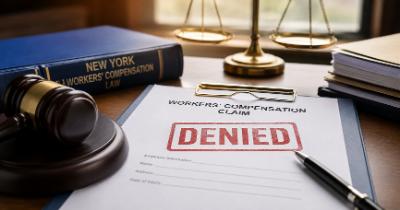
The word “denied” can describe different stages of a workers’ compensation claim. Your next step depends on whether an insurance carrier is disputing the initial claim or a Workers’ Compensation Law Judge has already issued a decision.
An employer or workers’ compensation insurance carrier may dispute, or “controvert,” an initial claim. In that situation, the carrier is telling the Workers’ Compensation Board that it contests some or all of your right to benefits. The Board may schedule a hearing before a Workers’ Compensation Law Judge. The judge can hear testimony, review medical and other evidence, order depositions, and decide whether the claim should be established.
A different process applies after a Workers’ Compensation Law Judge issues a decision. If you disagree with that decision, you may seek administrative review. The Workers’ Compensation Board states that an appeal from a judge’s decision generally must be filed within 30 days of the filing date of that decision.
A carrier dispute and an appeal from a judge’s decision are not the same stage. The procedure, evidence, and deadline depend on where your case stands.
Why Workers’ Compensation Claims Get Denied
A carrier may dispute a claim for several reasons. Some disputes focus on whether the injury arose out of your employment. Others concern notice, filing deadlines, medical proof, employee status, or the connection between your job and the claimed condition.
Common issues include:
- The insurer argues that the accident did not happen in the course of your employment.
- Your medical records do not clearly connect the injury or illness to your job.
- You reported the accident late, or there is a dispute about when notice was given.
- Form C-3 was not filed within the applicable time limit.
- The insurer claims that a prior injury or preexisting condition caused the current disability.
- Accounts of how the injury occurred are incomplete or inconsistent.
- The parties disagree about whether you were a covered employee.
- An occupational disease claim lacks enough medical or work-history evidence.
New York generally requires you to notify your employer within 30 days after a work-related accident. You should also file Form C-3 with the Workers’ Compensation Board as soon as possible. For an accidental injury, Form C-3 generally must be filed within two years of the accident.
For an occupational disease, the timing rule is different. A claim generally must be filed within two years after disability or within two years after you knew or should have known that the disease resulted from the nature of your employment, whichever is later. The facts of your case and any applicable legal exceptions can affect the result, so you should not assume that a missed date automatically ends every claim.
For more information about the first steps after a workplace injury, visit https://www.colesorrentino.com/buffalo-workers-compensation-lawyers/injured-on-the-job/.
What is Workers' Compensation? Do You Need a Workers' Comp Lawyer in New York?Related Videos
What Happens After an Insurance Carrier Controverts the Claim?
When a carrier formally disputes your claim, the Workers’ Compensation Board can schedule a hearing. A Workers’ Compensation Law Judge may hear testimony, review medical and other evidence, order depositions, and decide whether you are entitled to benefits.
If the claim is found compensable, the judge can determine the amount and duration of the compensation award based on the issues before the Board.
While the controversy remains unresolved, the insurer generally does not have to pay indemnity or medical benefits on the disputed claim. Health care providers may continue treating you during that period, and payment issues can be addressed if the claim is later established.
You can also review the firm’s information about denied claims at https://www.colesorrentino.com/denied-workers-compensation-claims/.
What Evidence Can Help Challenge a Workers’ Compensation Denial?
A denied or disputed claim often turns on the quality of the evidence. You should first identify the exact issue the carrier is challenging, then gather records that directly address that issue.
Useful evidence may include:
- The accident or incident report
- Emails, text messages, or written notices sent to a supervisor
- Witness names and contact information
- Emergency room records and treating-provider records
- Medical reports that address diagnosis, causal relationship, and work restrictions
- Photographs of the work area, equipment, or accident scene when relevant
- Payroll records and wage statements
- Job descriptions showing the duties you were performing
- Prior medical records if the carrier raises a preexisting condition
- A timeline showing the injury, report, treatment, lost time, and claim filing
- Copies of Board notices, carrier notices, and prior decisions
For example, assume you work in a Buffalo warehouse and hurt your shoulder while lifting a heavy item. The carrier argues that an older sports injury caused your current condition. Records showing your prior medical baseline, new symptoms after the workplace lifting event, diagnostic findings, and your treating provider’s opinion on causal relationship may become central evidence.
Your medical records should accurately describe how the injury happened, your diagnosis, your restrictions, and the provider’s opinion about whether your work caused or contributed to the condition. Inconsistencies between your testimony, accident report, and medical history can become disputed issues, so accuracy matters.
What Happens at a New York Workers’ Compensation Hearing?
A workers’ compensation hearing is a formal proceeding before the Workers’ Compensation Board. It is not simply another review of the claim paperwork.
At a hearing, the Workers’ Compensation Law Judge may:
- Identify the legal and factual issues that remain disputed
- Hear testimony from you or other witnesses
- Review medical reports and employment records
- Direct medical testimony or depositions
- Address whether the claim should be established
- Decide which body parts or conditions are covered
- Address average weekly wage and periods of disability
- Decide issues involving lost-time benefits or medical treatment
- Issue a written decision
Preparation can help you present your case clearly. Your testimony should be accurate and consistent with the written record. If your injury involved several body parts, prior treatment, changing symptoms, or an attempted return to work, organize those facts before the hearing.
For more information about workers’ compensation benefits, visit https://www.colesorrentino.com/buffalo-workers-compensation-lawyers/types-of-benefits/.
If a Workers’ Compensation Law Judge Denies Your Claim, How Does an Appeal Work?
If a Workers’ Compensation Law Judge issues an unfavorable decision, you may request administrative review by the Workers’ Compensation Board.
A party seeking Board Review generally has 30 days from the filing date of the judge’s decision to file the appeal. If you are represented by an attorney or licensed representative, the current Application for Board Review, Form RB-89, must be used.
The opposing party may file a rebuttal using Form RB-89.1. The Workers’ Compensation Board states that the rebuttal generally must be filed within 30 days after service of the application for Board Review on the party submitting the rebuttal.
A three-member Board panel reviews the appeal. The panel may:
- Affirm the judge’s decision
- Modify part of the decision
- Reverse the decision
- Return the case for additional hearings
The appeal should identify the issues for review, the portion of the decision being challenged, the requested outcome, and the basis for asking the Board to reach a different result. The Board also has specific rules for service, supporting documents, briefs, and new evidence.
You should not assume that sending a letter, resubmitting documents already in the Board file, or sending new medical records without following the Board’s appeal rules will preserve your rights.
Can You Appeal a Board Panel Decision?
A Board panel decision can lead to further review in some cases.
A party may seek Reconsideration or Full Board Review using Form RB-89.2. The Workers’ Compensation Board lists a 30-day filing period after notice of filing of the Board panel decision for that application.
Judicial review may also be available. An appeal from a Board panel decision may be taken to the New York State Supreme Court, Appellate Division, Third Department, generally within 30 days after the decision has been served on the parties.
These stages have separate procedural requirements. If you are considering further review, focus on the exact date of the decision, service requirements, the issues preserved in the record, and the correct form or court filing.
What Should You Do Immediately After a Workers’ Compensation Denial?
A clear response starts with the denial notice or Board decision.
- Read the notice carefully. Identify whether the carrier controverted the claim or a judge issued a decision.
- Identify the exact reason for the dispute. A late-notice issue requires a different response from a medical-causation issue.
- Keep treating with an appropriate health care provider. Make sure your provider has an accurate history of the workplace event and your symptoms.
- Preserve your records. Keep Board notices, carrier notices, medical reports, wage information, work restrictions, emails, photographs, and witness information.
- Track every date. The 30-day Board Review period after a judge’s decision can be especially significant.
- Review your medical proof. Confirm that the records address diagnosis, causal relationship, disability, and work restrictions when those issues are disputed.
- Consider legal guidance. An attorney can review the denial, Board file, medical proof, procedural posture, and available review options.
For an overview of the firm’s workers’ compensation practice, visit https://www.colesorrentino.com/buffalo-workers-compensation-lawyers/.
How a Buffalo Workers’ Compensation Attorney Can Help After a Denial
A denied claim can require you to manage medical treatment while also responding to legal, factual, and medical disputes. A workers’ compensation attorney can help you identify the stage of the case and focus on the evidence that addresses the carrier’s or judge’s reasoning.
Depending on the case, an attorney may help you:
- Review the denial notice and Workers’ Compensation Board file
- Identify missing medical or employment evidence
- Prepare for testimony at a hearing
- Address disputes involving causal relationship or a prior condition
- Review wage and disability issues
- Work with medical evidence that addresses the disputed condition
- Prepare a Board Review application when an administrative appeal is appropriate
- Track procedural deadlines and service requirements
Cole, Sorrentino, Hurley, Hewner & Gambino, P.C. has provided legal advice and representation in Western New York for more than 45 years. The firm has offices in Buffalo, Hamburg, and Batavia and serves clients in nearby Western New York communities.
If your New York workers’ compensation claim has been denied or disputed, you can request a legal consultation by calling 716-869-3011 or visiting https://www.colesorrentino.com/contact/.
A Denial Does Not Always End Your Workers’ Compensation Claim
The right response depends on the stage of your case. A carrier controversy can lead to a hearing before a Workers’ Compensation Law Judge. An unfavorable judge’s decision can lead to administrative review if the appeal requirements are met. A Board panel decision can involve additional review options under separate rules.
Start with the document you received, identify the disputed issue, preserve your evidence, and track the applicable deadline. Taking the correct procedural step can help you present the strongest available response to the denial.
This article is for general informational purposes only. It is not legal advice or a legal opinion about any specific facts or circumstances. Every workers’ compensation case is different. You should speak with a qualified attorney about your specific situation.